
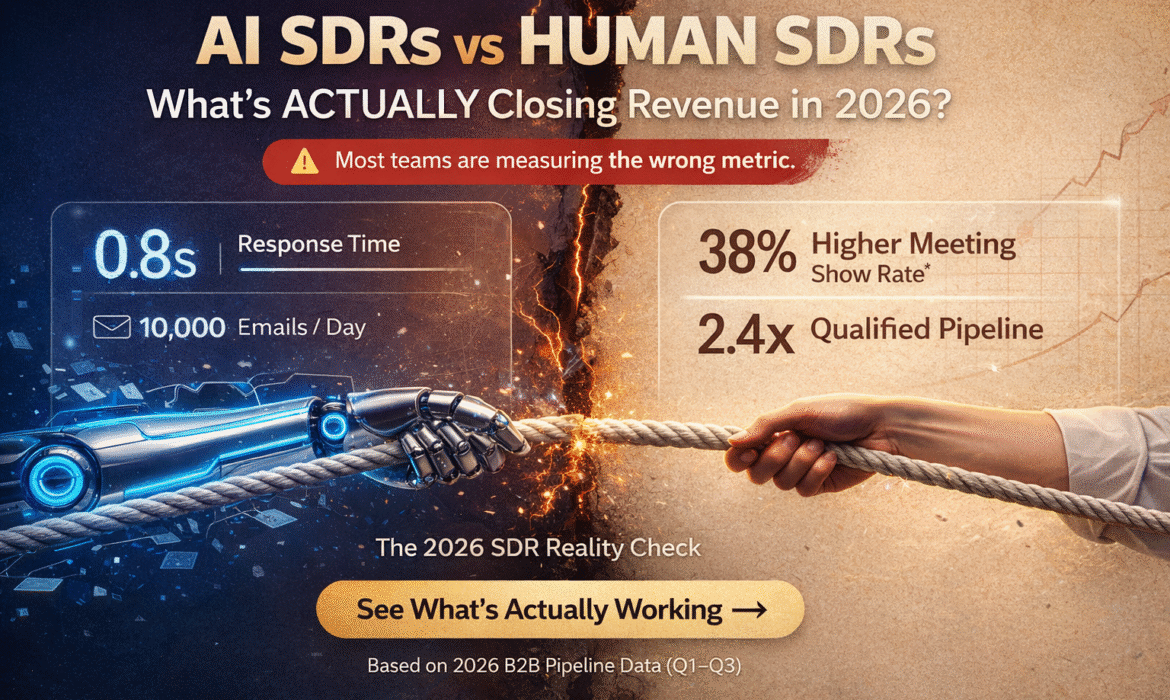
If you’ve fully replaced your SDR team with AI, you may have improved efficiency.
You may have also quietly damaged your pipeline quality.
In 2026, AI SDRs can:
- Personalize outreach at scale
- Optimize subject lines in real time
- Automate follow-ups flawlessly
- Score and prioritize leads with statistical precision
They are faster, cheaper, and more consistent than most entry-level reps.
But conversion in complex B2B sales has never been about activity volume.
It has always been about influence.
The Illusion of Efficiency
Founders see dashboards improving:
Higher open rates.
More meetings booked.
Lower outbound costs.
And conclude: the human layer is now optional.
Here’s the uncomfortable reality.
AI is exceptional at starting conversations.
It is significantly weaker at navigating what happens next.
Enterprise buying decisions involve multiple stakeholders, competing incentives, and internal politics. That environment is not structured. It is emotional, risk-driven, and often ambiguous.
AI optimizes patterns.
Complex buying behavior is not a clean pattern.
Where AI SDRs Win
Let’s be clear. AI belongs in the modern SDR stack.
It outperforms humans in:
- Prospect research at scale
- Data enrichment and signal tracking
- Sequence optimization
- Timing and cadence discipline
- Performance analytics
Removing humans from these tasks increases productivity.
The mistake is assuming productivity equals persuasion.
Where Human SDRs Still Drive Revenue
Deals do not stall because follow-ups were late.
They stall because:
- A CFO questions ROI exposure
- IT challenges security assumptions
- Operations fears disruption
- A champion loses political capital
A skilled human SDR identifies these signals early.
They adjust language in real time.
They coach champions on internal positioning.
They map power structures inside the account.
AI cannot interpret tension in a live conversation.
It cannot sense hesitation masked as curiosity.
It cannot navigate executive ego dynamics.
In high-value B2B sales, subtlety converts.
The False Binary
The market has framed this as a replacement debate.
That framing is flawed.
Companies that eliminate humans entirely often report strong top-of-funnel growth and weaker opportunity progression.
Companies that ignore AI entirely lose efficiency and margin.
The highest-performing teams in 2026 are not choosing sides.
They are redesigning roles.
The Model That’s Converting
AI handles:
- Scale
- Speed
- Signal detection
- Process discipline
Human SDRs focus on:
- Strategic qualification
- Stakeholder mapping
- Objection pattern recognition
- Champion enablement
AI generates volume.
Humans generate alignment.
Alignment drives revenue.
What Founders Should Actually Measure
If you’re evaluating SDR performance purely by:
- Meetings booked
- Activity volume
- Cost per conversation
You are measuring motion, not momentum.
More predictive indicators:
- Multi-threaded engagement per account
- Stakeholder expansion before close
- Opportunity progression velocity
- Quality of handoff to sales
Efficiency without alignment creates fragile pipelines.
The Strategic Position
The future is not AI vs Human.
It is architecture.
How deliberately have you designed collaboration between machine precision and human judgment?
Because in 2026:
Automation creates attention.
Judgment creates trust.
Trust closes enterprise deals.

