
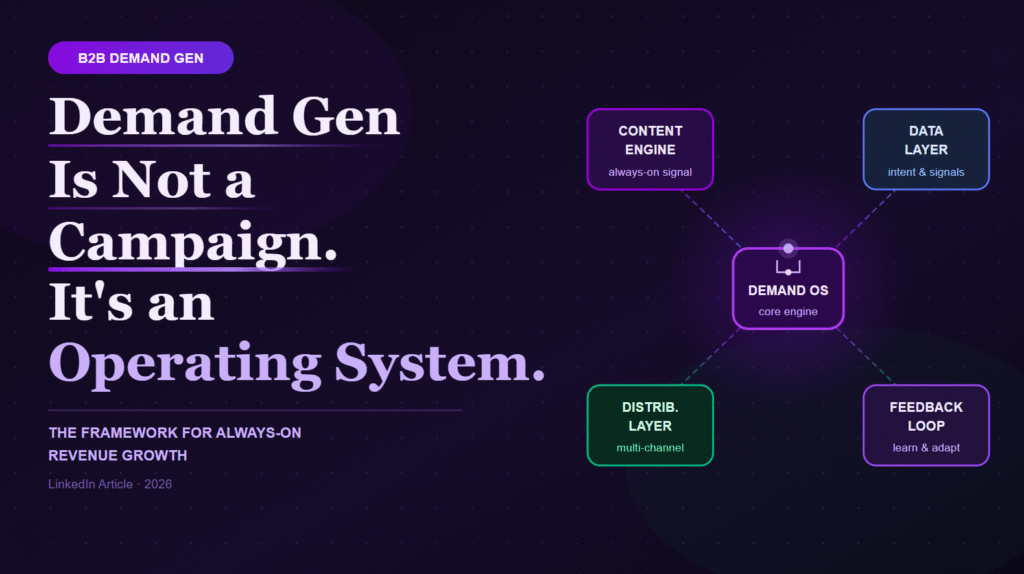
Most B2B marketing teams run demand gen in cycles.
Campaign goes live. Leads flow in for 6–8 weeks. Campaign ends. Leads dry up. Repeat next quarter.
That model is broken and it’s not a budget problem or a talent problem. It’s an architecture problem.
The teams winning in B2B today didn’t build better campaigns. They built an operating system.
The Campaign Trap
A campaign has a start date and an end date. Your buyer’s consideration window doesn’t.
67% of the B2B buying journey now happens before a buyer ever talks to sales. The moment you stop spending, your awareness disappears. There’s no compounding. No flywheel. No residual value.
Worse, campaign thinking creates internal dysfunction: marketing optimizes for MQL volume, sales optimizes for conversion rate, and neither team is pulling in the same direction at the same time.
Campaign-based demand gen is a rental model. You pay for attention every quarter and own nothing.
💡 “The best B2B marketing teams don’t turn off between quarters. They compound.”
The 4-Module Demand Gen OS
An operating system manages resources, runs continuously, and gets smarter over time. Your demand gen should do the same. It runs on four modules:
Module 1: The Content Engine
Always-on thought leadership that attracts buyers at every stage not gated ebooks tied to a campaign, but genuine POV content that ranks, gets shared, and builds category authority over time. It runs whether or not a campaign is active.
Module 2: The Data Layer
Real-time intent signals, firmographic triggers, and behavioral data that show you which accounts are in-market right now before they fill out a form. Job change alerts, third-party intent data, community engagement. This turns your ICP from a static list into a live, ranked, actionable feed.
Module 3: The Distribution Layer
Multi-channel presence that routes the right message to the right buyer at the right moment based on where they are in the buying journey, not your content calendar. LinkedIn, email, SEO, community, partners. The OS doesn’t spray. It targets.
Module 4: The Feedback Loop
The mechanism that makes everything compound. Win/loss data, pipeline conversion rates, content performance all feeding back into the Content Engine and Data Layer every month. After 12 months of running this loop, teams consistently report 30–50% improvement in pipeline efficiency without increasing budget.
🎯 KEY TAKEAWAY
The four modules aren’t separate programs they’re interdependent. Content feeds Data. Data guides Distribution. Distribution generates the inputs that power the Feedback Loop. You can’t run one in isolation and call it an OS.
Why This Is Different From “Always-On Marketing”
Always-on ads are just a slow campaign. That’s not an OS.
The difference is compounding. Every piece of content, every signal captured, every closed deal makes the system more effective the next month. It’s self-correcting by design not through quarterly retrospectives, but through feedback loops built into the architecture itself.
Where to Start
You don’t need to rebuild everything at once. Start here:
Audit your current activity — classify everything into one of the four modules. Most teams are strongest in Distribution and have almost no Feedback Loop.
Stand up your Data Layer — even a basic intent data subscription changes how you prioritize accounts.
Formalize your Content Engine — one owned media channel, consistent POV, published weekly.
Build the Feedback Loop last — once the other three are running, connect the outputs back to the inputs.
✅ TAKE ACTION:
Identify your biggest OS gap (most teams: Feedback Loop)
Define 3 signals that indicate a buyer is in-market before they raise their hand
Set one compounding KPI alongside each existing campaign metric
The Compounding Advantage
The teams that start building a demand gen OS now will have a structural advantage that’s nearly impossible to replicate by 2027.
You can’t catch compounding infrastructure with a Q4 campaign push.
The architecture is here. The only thing left is to build it.
Which of the four modules is your biggest gap right now? Drop it in the comments — We read every one.
B2B revenue strategist writing weekly on demand gen, pipeline architecture, and the systems that separate top-performing revenue teams from the rest. Follow for more.

