For four years, we built our ICP the way everyone told us to. Company size. Industry. Geography. Revenue range.
Neat. Clean. Completely useless.
Our win rate was stuck at 19%. Our sales cycles averaged 97 days. Half our “ideal” accounts churned within 18 months. Meanwhile, accounts we’d almost disqualified — ones that didn’t fit our firmographic profile — were renewing at 140% NRR and sending us referrals.
Something was deeply wrong with how we defined “ideal.”
This is the story of how we rebuilt our ICP from scratch — not by adding more firmographic filters, but by listening to the behavioral signals our best customers were already sending us.
The Firmographic Trap
Firmographics feel like intelligence. Industry, headcount, revenue range, tech stack — measurable, CRM-friendly, easy to hand to an SDR team. They create the illusion of precision.
But here’s what firmographics actually measure: what a company is, not what it’s doing. And buying behavior is the actual predictor of fit.
Firmographic profiles are built from your historical customer base — shaped by who you could reach, not necessarily who you could serve best. They’re lagging indicators dressed up as forward-looking criteria.
When we analyzed our own book of business, 68% of churned accounts had been flagged as “strong ICP fit” using the exact criteria we’d spent months refining.
What Revenue Signals Actually Are
A revenue signal is any observable behavior or event that correlates with an account’s readiness to buy, expand, or churn. Unlike firmographics, signals are dynamic. They move in clusters. And when you read them together, they become remarkably predictive.
After 14 months of research across our customer base, four categories emerged:
Growth Signals hiring velocity in target functions, funding rounds, new market entry, headcount expansion in relevant departments.
Pain Signals executive content describing the problem you solve, job posts that essentially describe your product, stack changes like dropping an incumbent tool.
Intent Signals multiple contacts at the same account engaging your content, visits to pricing or comparison pages, review site research activity.
Timing Signals leadership change (new CRO, CMO, VP), end of fiscal year, M&A activity, competitive displacement events.
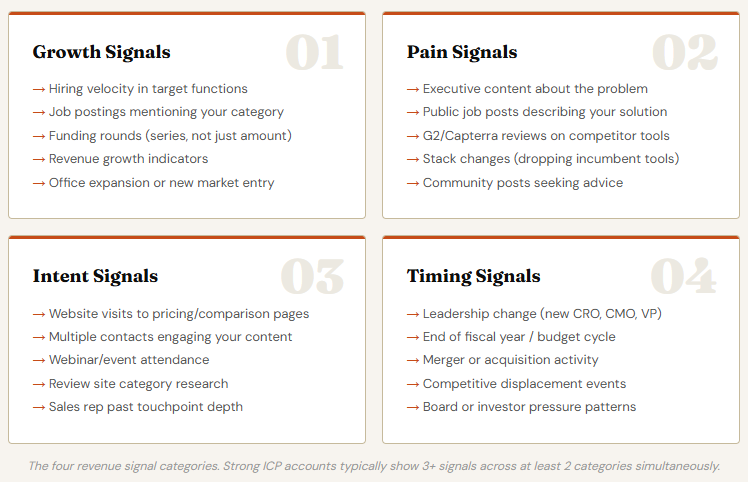
No single signal is decisive. What matters is signal density and clustering. An account showing three growth signals and a timing trigger is fundamentally different from one showing a single intent signal even with identical firmographic profiles.
The accounts that churned all shared a pattern in retrospect: right profile, wrong moment. They weren’t hiring for the roles our product enabled. Leadership wasn’t actively articulating the problem we solved. They fit our category but they weren’t in our moment.
⚠️ Common mistake: Treating intent data as a complete solution. Intent captures research behavior it’s one signal in one category. Accounts with high intent scores but no growth or pain signals converted at nearly the same rate as cold outbound. The cluster matters, not the individual signal.
How We Rebuilt the ICP in 90 Days
We didn’t add signals to our existing ICP. We put it in a room, interrogated it, and started over with data as the only witness.
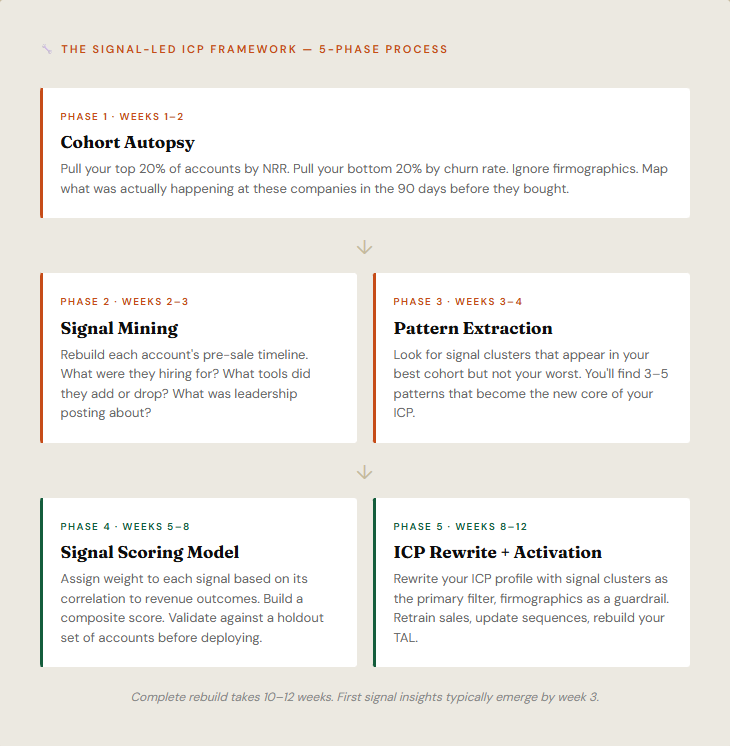
What the autopsy revealed: The firmographic overlap among our best customers was lower than expected — enterprise and mid-market, North American and European, SaaS and manufacturing. What they shared was behavioral.
In the 90 days before purchasing, 87% of our best accounts had made at least one leadership hire in a function our product directly supported. Not a funding announcement. Not a revenue milestone. A new hire in a role where our product would matter to their success immediately.
That single finding changed everything.
The five signal clusters that became our new ICP:
Leadership hire + tech stack gap → Win rate: 54%
Funding event + executive pain content → Win rate: 47%
Competitor churn signal → Win rate: 61%
Multi-contact intent (3+ contacts in 30 days) → Win rate: 43%
Fiscal year-end + hiring velocity in buyer’s function → Win rate: 39%
None of these were visible through our old ICP lens.
🎯 Key takeaway: The cohort autopsy is the most valuable two weeks you’ll spend on ICP work. Don’t delegate it. The patterns that emerge will contradict assumptions you’ve held for years — that discomfort means you’re doing it right.
The Results
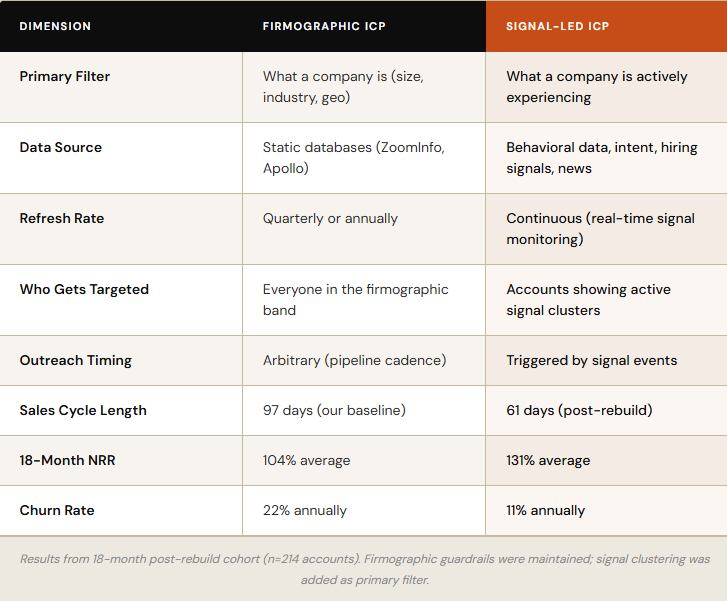
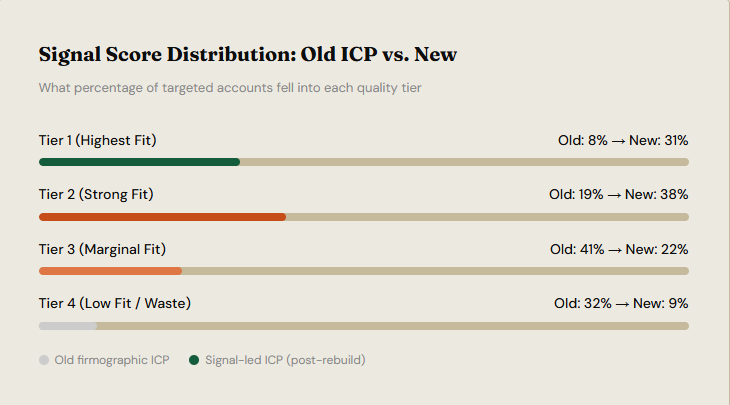
Win rate: 19% → 26% overall. Tier 1 signal accounts closed at 54%.
Sales cycle: 97 days → 61 days.
Average NRR: 104% → 131%.
Annual churn: 22% → 11%.
But the metric I’m proudest of isn’t in those numbers.
Our SDR team’s morale went up.
The old model had reps spraying sequences into firmographic buckets, hoping the 8% who were actually in-market would respond. The new model gave them 40 accounts signaling readiness — and a reason to call that went beyond “you fit our profile.”
When you give salespeople a list of companies genuinely experiencing the problem you solve, selling becomes a different activity entirely. Conversations change. Close rates follow.
How to Start in 30 Days
You don’t need a full RevOps team or a six-figure data contract. Here’s a lean version any B2B company with 50+ customers can execute now.
Tools we use (no affiliate relationships): LinkedIn Sales Navigator for hiring and leadership signals, Bombora layered on top of clusters for intent overlay, Crunchbase Pro for funding triggers, G2 Buyer Intent for competitive displacement plays, and Clay for aggregating signals into a single account score.
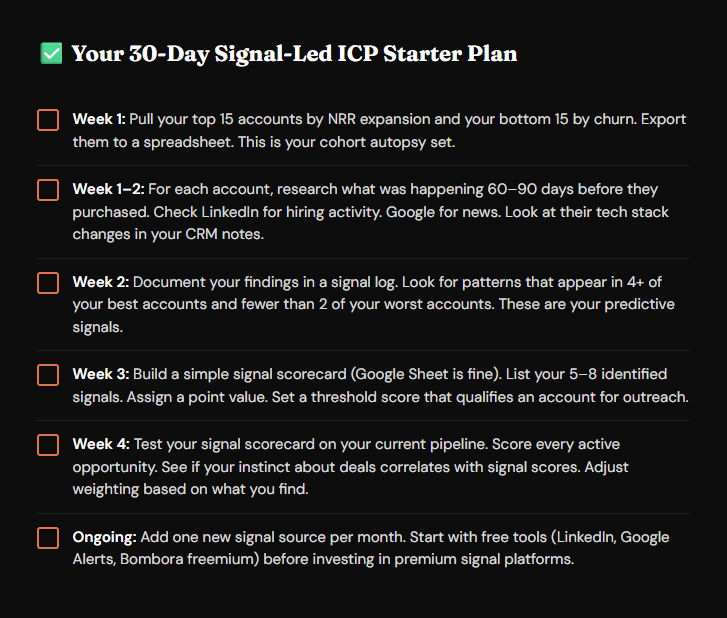
⚠️ Don’t buy tools before you build the model. We licensed three intent platforms before knowing which signals actually predicted revenue for us. Tools amplify your model they don’t replace the work of building one. Do the cohort autopsy first.
What This Means Going Forward
The companies winning in B2B right now aren’t the ones with the most accurate firmographic databases. They’re the ones who’ve learned to read what their market is actually doing in real time.
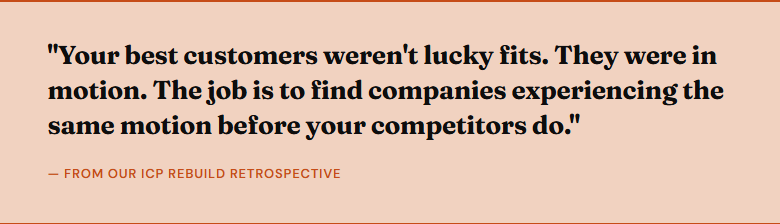
Your best future customers are already announcing themselves through hiring patterns, content behavior, stack decisions, and timing events. The question is whether you have a system to hear them before your competitors do.
Start with the cohort autopsy.
The rest follows.